Südtirol Guide App Logo
Przejdź do treści

dodano do ulubionych

usunięto z ulubionych

Coś poszło nie tak! Wystąpił problem. Spróbuj ponownie

Twoje konto jest właśnie tworzone

Twoje konto zostało pomyślnie utworzone i jesteś teraz zalogowany

Zalogowałeś się pomyślnie!

Twoje konto zostało pomyślnie utworzone, ale nie mogliśmy zalogować Cię automatycznie

Jesteś wylogowany

Filtr
Wybrane filtry
    Poziom trudności
    Czas trwania
    Odległość w km

    Wszystkie winiarnie na południu Południowego Tyrolu

    Zanurz się w tradycji winiarskiej południowego Tyrolu. Odwiedź regionalne winnice, poznaj sztukę produkcji wina i delektuj się degustacjami, które oczarują Twoje zmysły.

    Wyniki
    Wineries
    K.Martini & Sohn
    Eppan an der Weinstaße/Appiano sulla Strada del Vino, Alto Adige Wine Road
    Anyone who has been passionately active in the wine sector for a long time wants to put their own stamp on wines at some point. That may be at their own risk, but in fact also with their own signature. That is precisely what the Martini family has done, and it was now more than forty years ago that the K. Martini & Sohn Winery in Cornaiano was brought to life.

    The K in K. Martini & Sohn stands for the father Karl Martini, who founded the winery in 1979 with his son Gabriel, and specifically in the middle of their own vineyards in the winegrowing village of Cornaiano, which belongs to the community of Appiano. At that time, both father and son had already made their careers in the sector, so they brought along the necessary know-how and the experience regarding wine that was essential for their success.
    In spite of that, the step to being on their own was not an easy one: “Building up the winery was a hard piece of work,” Gabriel Martini recounts today. “We filled, sealed, and labeled the first bottles by hand.”

    Because they were well aware of their size (or lack thereof), they understood themselves at K. Martini & Sohn from the very beginning to be a small but fine operation that focuses not only on comprehensive and friendly service, but also above all else on quality. “That alone justifies the existence of a small family operation,” says Martini.
    In addition, it is built upon a palette of wines that is astonishingly large for a small operation which today comprises four lines and ranges from Pinot Blanc, Pinot Grigio, and Pinot Noir to Chardonnay, Sauvignon Blanc, Schiava, and Lagrein all the way to Yellow Muscat and Red Muscat.
    Wineries
    Winery T. Pichler
    Kaltern an der Weinstraße/Caldaro sulla Strada del Vino, Alto Adige Wine Road
    Thomas Pichler knows wine in all of its facets and, in fact, in greater detail than most others. And that is not just because he comes from a family of Caldaro winegrowers and therefore himself grew up with wine cultivation. Rather, it is because he has worked for nearly three decades in different wine laboratories. But since wine under laboratory conditions obviously was not sufficient for him, he also now produces wine himself – at the Thomas Pichler Estate Winery in Caldaro.

    The question that immediately comes to mind with such a career is: how does the know-how from the laboratory get transferred into practice? And the answer from Pichler is surprising: “With winemaking, I do not depend very much upon theory,” he says, “but rather with all of my decisions, I rely upon feeling, upon my nose and mouth.” In the end, it is not about bottling some trendy wine with all sorts of aids, but rather producing independent wines that are characteristic for the variety, area, and grower.
     The winegrower places correspondingly great value upon the selection of variety, whereby his heart lies above all else with indigenous grapes and classic wines.

    Thus Lago di Caldaro and Lagrein make up nearly half of the production, followed by Chardonnay and Sauvignon Blanc. And with sales, as well, Pichler follows the long-established routes. His wines are sold at the winery, at select wine bars, and to dining establishments.
    Wineries
    Wine-growing estate Lieselehof
    Kaltern an der Weinstraße/Caldaro sulla Strada del Vino, Alto Adige Wine Road
    In the middle of the nineteenth century, when Franz Morandell built a farmhouse, he at the same time also immortalized his wife. Her name was Elisabeth, which in its loving nickname becomes “Lisele”. Today, the Lieselehof Estate Winery in Caldaro is an imposing estate in which the winegrowing knowledge of three generations meets together and where Werner Morandell has the say. He is the great-grandson of “Lisele”.

    The fact that with this story, the Morandells inherited their passion for wine right from the cradle may sound like a platitude. Except that it is true. Werner’s grandfather was a winegrower, while his father Gottlieb-Amadeus attended to the grafting of young grapevines and produced rootstock for surrounding vineyard nurseries.

    Werner Morandell also thoroughly devoted himself to winegrowing. He even wrote a book about it and along with his vineyard, he is a contractual partner of the Freiburg in Breisgau State Viticultural Institute in Germany. Within that context, the main attention lies with fungus-resistant varieties, on the organic cultivation of traditional grape varieties (such as Schiava and Cabernet), and on wines that are made in an ecologically friendly manner. “That means that during the vinification, only a few natural treatment agents are permitted, and we completely do without synthetic materials,” Morandell says.

    The particular pride of the Morandells is wines that are made from exclusively fungus-resistant grapes for which no chemical herbicides are used in the vineyard and for which strict conditions are met for grape yields per vine. A separate brand name has even been developed for them: Green Mountain Wine.
    Wineries
    Pitzner Winery & Suites
    Karneid/Cornedo all'Isarco, Dolomites Region Eggental
    The history of the Pitznerhof in Cardano is almost like the story of beating swords into plowshares. The name “Pitzner” is a corruption of “Büchsner”, referring to someone who makes shotguns who was active earlier at the farm. So for both pacifists and gourmands, that is good news, since at the Pitznerhof, they turned their back on tradition and made wine instead of weapons.

    The brothers Markus and Thomas Puff are responsible for the wine production at the impressively 700 year-old Pitznerhof in Cardano at the entrance to the Valle Isarco. Their farmhouse lies at an elevation of precisely 350 meters, but the three hectares of grape growing areas are on steep slopes with deep, sandy weathered porphyry soils. “We attempt to integrate the local conditions and the microclimate into the production process in the best possible way,” says Markus Puff.

    And in the winery, there is also the underlying principle of working with the grapes gently. Thus the overall picture comes together of production that is close to nature along the entire chain. “We try to fulfill our responsibility by stressing nature as little as possible,” Puff says.

    This approach also forms the cornerstone for the quality of the wines from the Pitznerhof in Cardano. The product line includes Pinot Grigio, Pinot Blanc, Schiava, and Lagrein: potent, fine-structured white wines with pleasant freshness and a fine mineral-rich quality, but also spicy, pleasantly fruity, and lively reds.
    Wineries
    Seeperle
    Kaltern an der Weinstraße/Caldaro sulla Strada del Vino, Alto Adige Wine Road
    We - Ingrid and Arthur Rainer - have gone the indirect way, looked around and permanently learned. As a consequence, we want to go an open, modern and future-oriented way. In 2013 a new milestone was set. For the first time all the grapes of the family-owned vineyards were vinified in our cellars.
    Wineries
    Himmelreich-Hof
    Kastelbell-Tschars/Castelbello-Ciardes, Vinschgau/Val Venosta
    It is not without reason that the Monte Mezzo dì-Sonnenberg carries its name [“Midday Mountain” in Italian, “Sun Mountain” in German]. More than 250 days of sun per year can be counted here, the temperature differentials between day and night are extreme, and the amount of precipitation is lower than anywhere else in Alto Adige. These extraordinary conditions are used by Markus Fliri at the Himmelreich-Hof in Castelbello in order to produce wines with strong character.

    Even if Castelbello does not lie within a typical winegrowing zone, wine has been produced at the Himmelreich-Hof since time immemorial. At least for their own use. But in 2004, that was no longer enough for the winegrower Fliri. He wanted to increase the production of quality wines at his estate and also offer them for sale – “interesting, top-quality wines” as the winegrower himself says.

    The vineyards of the Himmelreich-Hof, just precisely two hectares, lie at an elevation of 650 meters, and the moraine soils, a remnant of the last ice age, have a high mineral content which can be tasted in the grapes. And thus also in the wine. “It is a matters of importance to us to produce natural, sincere wines with strong character,” says Fliri.

    His assortment comprises Zweigelt, a red cuvée to which he has given the name “Himmelreich” [“Kingdom of Heaven”], and Pinot Noir. The young wines are transferred into small oak casks to age there and be able to mature in complete tranquility. In addition to those, there is also Pinot Blanc and, new to the Himmelreich-Hof’s assortment, Riesling.

    So its name was not chosen by chance. At least for wine connoisseurs.
    Wineries
    Unterwirt Winery
    St.Martin in Passeier/San Martino in Passiria, Meran/Merano and environs
    There is a vineyard in the Passiria Valley. One single one. It belongs to the Unterwirt Winery of the Martinerhof in S. Martino, by which the Fontana and Schweigl families have expanded their universe that previously consisted of a beer experience hotel, pizzeria, and in-house brewery. At the same time, they brought back to life an inn in which Tyrolean freedom fighter Andreas Hofer came and went.

    The Unterwirt Winery of the Martinerhof carries two names at once. That of the Martinerhof is used because it is a part of the gastronomy world around the farmhouse, but it is also right at home with Unterwirt. The inn was first mentioned in a document in 1694, and it was renovated in 2012. “Because the vineyard of the neighboring Hianhof is the first one in the valley and also the only one, we set up a winery in the Unterwirt, and also to breathe new life into the establishment,” says Florian Fontana.

    A remarkable assortment of wines are produced in the winery today. They range from Schiava and Pinot Noir to Sylvaner and all the way to Kerner and Pinot Blanc. So even though there is only one estate winery in the Passeier Valley, its results can easily be seen. And speaking of being seen: at the Unterwirt Winery of the Martinerhof, experience tours are also offered.

    Even if the significance of winegrowing in the Passiria Valley is easy to understand, the importance of the wine there is not. Andreas Hofer, the Tyrolean hero from this valley, was a wine dealer and wine connoisseur. Perhaps it is also for that reason that before his execution by Napoleon’s troops in 1810, he ordered, “For all good friends, there will be soup and meat at the Unterwirt, along with a half bottle of wine.”
    Wineries
    Geier Simon Plonerhof
    Bolzano/Bozen, Bolzano/Bozen and environs
    In Santa Maddalena, tradition is written with capital letters, and the Plonerhof Estate Winery in Bolzano is no exception to that. On the contrary, the farmhouse itself goes back to the thirteenth century, and the vines with which Simon Geier works are over seventy years old. So with so much history, a careful, gentle approach is practically a self-evident fact.

    In the vineyard of the Plonerhof Estate Winery in Maddalena di Sotto, therefore, prudence and work that is close to nature are called for, which in turn means: a lot of work by hand. That is in fact associated with a certain degree of toil, but it also has its effect upon the quality of the grapes. “When we work in the vineyards by hand, we achieve a great degree of control because we experience the grapes with all five senses,” Geier explains.

    Added to work by hand is the fact that herbicides are totally avoided, and they almost completely do without insecticides. “We only have to act against the spotted wing drosophila, because otherwise it would destroy the entire harvest,” the winegrower tells us.

    Once the harvest is brought in, classic Santa Maddalena is made from Schiava and Lagrein grapes in the estate’s own winery, as well as a fruity Lagrein and a cuvée of Yellow Muscat and Pinot Blanc. With their wines, the Plonerhof Estate Winery has also brought home a whole series of prizes and awards. So anyone who understands how to deal with ancient grapevines is rewarded with the highest quality. The Methuselahs are, so it seems, in a generous mood.
    Wineries
    Winery Romen
    Eppan an der Weinstaße/Appiano sulla Strada del Vino, Alto Adige Wine Road
    Winegrowing in Appiano has no fewer than two thousand years of tradition. Two thousand years in which winegrowers of all eras have made use of the ideal location, the mild climate, and the fertile soils on the ridge near the Passo Mendola for growing grapes and making wine from them.

    It is not surprising that such a lengthy tradition is anchored in the winegrowing operations and winegrower families. And at the Weinberghof, the Romen family does not constitute an exception. It is in the district of Appiano-Monte in which history and tradition become especially tangible, as there is a density here of manors, castles, and fortresses that knows no equal.

    The Weinberghof in its typical Oltradige style joins in this tradition. The view from the terrace looks out on the surrounding countryside and the numerous vineyards – including those of the Romen family. “We make use of the ideal location here with numerous hours of sunshine that is especially beneficial to the maturing of the grapes,” explains Alois Romen. “And during the night, katabatic winds provide cooler temperatures. These substantial temperature differentials between day and night are responsible for the prominent aroma of our wines.”
    But wine enthusiasts can convince themselves of this, and specifically right at the Weinberghof. Their own wines can be tasted here properly – in the winery which, with its old stone arches, is reminiscent of olden days. As one learns, tradition extends into the details.
    Wineries
    Finkhof Merano
    Meran/Merano, Meran/Merano and environs

    A statue of Blasius Trogmann stands in the Merano neighborhood of Maia Bassa, where a street is named after him, too. That is not a coincidence: Blasius Trogmann is regarded as Andreas Hofer’s most important ally in the Tyrolean Rebellion of 1809. A native of Merano, Trogmann had another passion apart from the one for his home, however: wine growing and winemaking.

    Blasius Trogmann was able to pursue that particular passion at his home, the Finkhof estate in Hagen, a Merano neighborhood with generous sunlight situated between the spa town proper and the Trauttmansdorff Castle Gardens. A contemporary chronicler notes: “(...) in the quiet and tranquil grounds of Hagenach, the vines, turned toward the midday sun, cook a delicious juice.”

    People realized very early that Hagen was a suitable area for wine growing: the Finkhof estate was first mentioned in a document in 1213. In the 18th and early 19th century, the aforementioned Blasius Trogmann would be the one to work that land and deliver his wines all the way to the capital of the Austrian empire. Even today, more than 200 years later, the estate is still run by the Trogmann Innerhofer family. And they are still passionate about wine, which they also sell in their very own farm store, the Bottega contadina Merano. All four members of the family work in the business, making a living from wine growing.

    Wines produced by the Finkhof winery include a light and fruity Schiava (Vernatsch), an intense Merlot, and a complex Lagrein. In addition, traditional methods are used to process Schiava grapes into sparkling wine, which is sold under the brand name “Hagenach,” named for the area where it grows and matures. Last but not least, the range is rounded off with an elegant white cuvée bearing a name which proves that the people of the Merano Finkhof winery feel an obligation toward their family and estate heritage: it is called “Blasius.” 

     
    Wineries
    Wassererhof
    Barbian/Barbiano, Brixen/Bressanone and environs
    “Wasserer” is not the German word for someone who waters, but rather the name of a farm in Novale di Fiè which has a view of the southernmost end of the Valle Isarco. The Wassererhof in Fiè allo Sciliar is run by the twin brothers Christoph and Andreas Mock. Christoph takes care of the agriculture (and thus of winegrowing), while Andreas handles the cooking at their Buschenschank farmhouse inn.

    The Wassererhof in Fiè was once called “Hof zu Wasser”, meaning that it was close to a spring which promised sufficient water and thus fruitfulness. Built in 1366 by the lords of Lichtenstein, the historical farmhouse fell more and more into a state of disrepair until 1996 when, greatly in need of renovation, it was purchased by Franz Mock, the father of twin brothers.

    Because the senior in Coste near Bolzano was running his own estate winery and Christoph had furthermore completed the Technical College of Agriculture, the decision was obvious to also turn the Wassererhof in Fiè into a winegrowing farmhouse. Since that time, Christoph has run it with determination, expert competence, energy, and a philosophy all his own. “Our goal is to create wines with aspirations, beauty, and grace,” he says, “and flowing into this goal is all of our knowledge that has grown over generations and our passion for the vineyard and the cellar.”

    It is out of knowledge and passion that a product line has come into existence at the Wassererhof in Fiè that consists of Schiava, Sauvignon Blanc, Cabernet, and Pinot Blanc – wines, in fact, with aspirations, beauty, and grace.
    Wineries
    Ansitz Villa Rasslhof
    Tramin an der Weinstraße/Termeno sulla Strada del Vino, Alto Adige Wine Road
    Winegrowing and wine production at the Ansitz Villa Raßlhof winegrowing estate are resting on a solid foundation—in more ways than one. For one, there is the historical foundation that was laid by the great-great-grandfather of Walter Gamper, the current head of the estate, when he built the Raßlhof farm in 1889. In other words: a passion for wine has run in the Gamper family for five generations.

    But also the name of the winegrowing estate itself makes a reference to this solid foundation: this is where the necessary conditions for any kind of winegrowing were being created over decades by cultivating young vines—also known as “Rasln.” They were cultivated right where the vines of one of the smallest DOC wine producers in Alto Adige are located today.

    Small or not: strict requirements are in place at the Raßlhof at all times. The Gamper family has always operated their vineyards in harmony with nature; processes in the cellar, on the other hand, are dominated by tradition, which also guides the aging of the wines.

    And there is another thing that just goes to show that the Ansitz Villa Raßlhof in Termeno is a true one-stop shop: grapes are not only cultivated and made into wine here. The wine thus created can also be enjoyed straight away at the private wine tavern of the Ansitz Villa Raßlhof on the Alto Adige Wine Road.
    Wineries
    Cantina Sankt Pauls
    Eppan an der Weinstaße/Appiano sulla Strada del Vino, Alto Adige Wine Road

    The imposing church, which also decorates their logo, is a witness to the importance which the town had in the Late Middle Ages – not least because of the favorite wines from the area. At that time, San Paolo was the main village in Oltradige, and even today, historical winegrowing farmhouses line the picturesque lanes.

    Top wines are now produced, such as Sanctissimus, made from Pinot Blanc vines that are more than one hundred years old, or the Praeclarus sparkling wine, which is aged to perfection in a bunker from the Second World War. A total of two hundred winegrowing families tend 185 hectares of vineyards at elevations ranging from 300 to 700 m above sea level. In 2019, they completely redid their product line. Allow yourself to be surprised!
    Wineries
    Loacker Wine Estates
    Bolzano/Bozen, Bolzano/Bozen and environs
    That which is more and more gaining a foothold today was still being laughed at forty years ago. Rainer Loacker, the patriarch of the estate winery of the same name in Bolzano, didn’t care. He had already gotten started with biodynamic winegrowing back in the 1980s. Or, to put it better, he revved it up.

    That term is a much better description of the development that the Loacker Estate Winery has gone through up to today. For instance, in addition to the historical pillar in Alto Adige, two more were added. In the form of two estate wineries in Tuscany: one in Montalcino and one in Maremma.

    But it doesn’t matter where Loacker grapes grow: they are tended strictly biodynamically. “Because we have been doing that for so long, we have soils filled with life and we are also among the very few who use homeopathy in the vineyard,” Loacker explains. Added to that is a very particular form of green manure. In plain language, that means that in the winter, greenery is sown in the vineyards which makes artificial fertilizers superfluous. “We are open-minded thinkers and rebels, we challenge the status quo and the mainstream society,” the Loacker family announces.

    And it goes without saying that the open-minded thinking also continues in the winery. Thus all wines, including the bold Tasnim Sauvignon Blanc and the outstanding Gran Lareyn Lagrein are fermented only with their own natural yeast from that vintage. “Our natural wines are simply different,” the Loackers explain. “They have their own character, and they have a soul.”
    Wineries
    Noafer
    Jenesien/San Genesio Atesino, Bolzano/Bozen and environs
    Noafer in Cologna (San Genesio) is known for miles around as an inn and estate winery. It is located on the southwestern slope of Monzoccolo on a sunny, flat, natural terrace at an elevation of 770 meters [2,530 feet] above sea level and – also because of this unique location – it is a favorite destination for an excursion. Not everyone who stops in for a refreshing drink or a bite to eat realizes that 2.7 hectares (6.7 acres) of vineyards also belong to the estate.

    Within that context, the roots of the farmhouse reach far back. As early as the Middle Ages, Noafer was one of the farms supplying the nearby Greifenstein Castle, so at that time, it had to provide the broadest possible palette of products. Today, the farm is run by Andreas Lamprecht, and the inn of the same name by his sister, Maria Lamprecht.

    Andreas is responsible for the farm and the winegrowing. He makes use of the ideal location of his vineyard, which profits from both the mild temperatures of the Adige Valley and the high elevation. These ensure that the soils, vines, and grapes can cool down at night, even in the middle of summer. “In the autumn, shortly before the harvest, the temperature differentials between day and night are especially tangible, which lends our wines a lot of aroma and a lively freshness,” Lamprecht explains.

    When the Noafer grower speaks of “our wines”, then he means Pinot Blanc, Pinot Noir, Schiava (Vernatsch), Zweigelt, Sauvignon Blanc, and Pinot Grigio – a thoroughly impressive assortment that is grown by Noafer in Cologna (San Genesio) and then makes its way to the wine list of the Noafer inn. Much to the pleasure of the guests.
    Wineries
    Zollweghof Lana - organic farm
    Lana, Meran/Merano and environs
    For thirty years, Franz Josef Pfeifhofer has dedicated himself to organic and biodynamic cultivation. At the organic Zollweghof Estate Winery in Lana, he makes wines of the highest quality from fungus-resistant varieties and creates completely new wines – including one with lemon balm.

    The Zollweghof in Lana is a small, family-run winegrowing operation whose winery dates back to the fourteenth century. In these historical surroundings, winegrower Pfeifhofer matures his wines in old large wooden barrels and clay amphorae. In so doing, he uses long-established methods which only enhance the biodynamic cultivation at the estate. “My grapevines are fungus-resistant, so I hardly need to treat them: applying sulfur twice at the most suffices,” Pfeifhofer says.

    And doing all of the work in the vineyard by hand also fits in with this philosophy. And for the grower, there is no alternative, since the vineyard areas are so steep that work by machine would in any case be impossible.

    As a winegrower, Pfeifhofer has set for himself the goal of making “great, modern top wines” from fungus-resistant varieties. And to do so, he is prepared to travel unconventional paths. His glowing rosé sparkling wine “Swing”, for instance, is intended as an aperitif, while “Melissa gold” can be drunk as a digestive. “We have refined this wine with bee balm, thus combining the knowledge of organic wine with the knowledge of nature and herbs,” Pfeifhofer says.
    “This knowledge is ancient,” he adds. And yet totally new.
    Wineries
    Ansitz Rynnhof
    Tramin an der Weinstraße/Termeno sulla Strada del Vino, Alto Adige Wine Road
    Welcome to Bethlehem! No, not the one you’re thinking of, but rather in Termeno. In the local vernacular, its oldest quarter is called – yes, really! – Bethlehem, and that is where one of the oldest farmhouses is found in the winegrowing village in the south of Alto Adige: the Rynnhof. And even if there is an obligation to history, the operation is more than modern.

    The historical estate “an der Rynnen” appears in a document for the first time in 1438. Not only is it located right in the middle of the vineyards of Termeno, at the time it was in fact at a watercourse from which its name is derived. The watercourse is no longer there today, but the vineyards are. And since 2011, they have been managed by Johann and Nathalie Bellutti strictly according to organic guidelines. “This method of cultivation and our connection to nature make our wines something special,” Johann Bellutti says with conviction.

    He was born at his parents’ Rynnhof with its medieval heart of a building, the stone-framed window flanning, and rounded arch gates, and this is where he also discovered his calling for winegrowing. And he cultivates his career and his calling, as he himself says, “In the Termeno tradition and the carefree quality of young ideas.”
    And thus wines with great character come into being: Pinot Blanc, Lagrein, Schiava, and, it goes without saying for Termeno, Gewürztraminer. For them, for his products, Bellutti has coined a slogan that is as simple as it is catchy. He calls it plain and simply “Free Wines”.
    Wineries
    Strasserhof Winery - Hannes Baumgartner
    Natz-Schabs/Naz-Sciaves, Brixen/Bressanone and environs
    The grapevines that are tended at the Strasserhof Estate Winery in Varna are up to 45 years old. From the grapes of these vines, Hannes Baumgartner, winegrower at the Strasserhof and, at the same time, president of the Independent Winegrowers association, makes youthful-fresh wines. White wines, of course, since we are in the Valle Isarco after all.

    The strictly white assortment of the Strasserhof Estate Winery is a thankfully broad one. It ranges from Müller Thurgau and Grüner Veltliner to Sylvaner, Riesling, and Gewürztraminer all the way to Zweigelt. And of course includes Kerner, upon which Baumgartner has placed particular focus. “Our characteristic Valle Isarco wines can without a doubt be described with three attributes: a strong mineral quality, great juiciness, and pleasant, youthful freshness,” Baumgartner says.

    Since 2003, he has been producing wine at the Strasserhof, an operation whose history in any case dates back much further. “The farmhouse was already built in the eleventh century,” the winegrower explains. Today, the estate winery encompasses five hectares of vineyards that are distributed over sunny locations with a southwestern exposure at elevations from 650 to 700 meters. “The lightly sandy gravel soils contribute to the elegant, fruity freshness of our wines,” says Baumgartner with conviction.
    Thus around 45,000 bottles of white wine are produced each year, for which the chairman of the Independent Winegrowers in Alto Adige has developed a broad market. So today, wines from the Strasserhof are drunk not only in Italy, Austria, and Germany, but also in the Netherlands, Japan, and the USA.
    Wineries
    Winery Fliederhof
    Bolzano/Bozen, Bolzano/Bozen and environs
    The Fliederhof ["Lilac Estate"] in Bolzano/Santa Maddalena really ought to be called “Tulpenhof” ["Tulip Estate"]. “Twenty years ago, we planted some tulip bulbs, and now in the springtime, the vineyard below the farmhouse turns into a whole sea of tulips,” recounts Stefan Ramoser. But it doesn’t matter whether it is lilacs or tulips: the Fliederhof in Bolzano/Santa Maddalena does not have any flowers in their product line, but rather produces genuine, natural wines.

    In the possession of the Ramoser family since 1930, grape growing areas of three hectares are currently managed, whereby it is nature who sets the tone. “The method of operation and the planning of all production steps both in the vineyard and the winery should not influence the course of things to the greatest degree possible,” says Ramoser.

    The vineyards of the Fliederhof in Santa Maddalena have a slope of up to 40 percent, so as a result of the steepness, they can only be tended with a great amount of work by hand. Ramoser is therefore convinced that precise work in the vineyard contributes to success as much as the natural conditions do – soil, rain, wind, and sun, and his own concept of sustainability. Added to that is greenery management that is adapted to the location for the building up of humus, but also the application of compost from their own production.

    All of this ought to be tasted in the result: “Wines from the Fliederhof ought to enjoy special drinking pleasure,” says the winegrower Ramoser. “Sincere, natural, and with character, without any special styling that could mask these properties.” And in view of the location, the fact that these wines also include Schiava – Santa Maddalena is a given. Or, as Ramoser puts it, “We view ourselves as a genuine champion of this indigenous grape variety.”
    Wineries
    Winery Calvenschlössl
    Mals/Malles, Vinschgau/Val Venosta
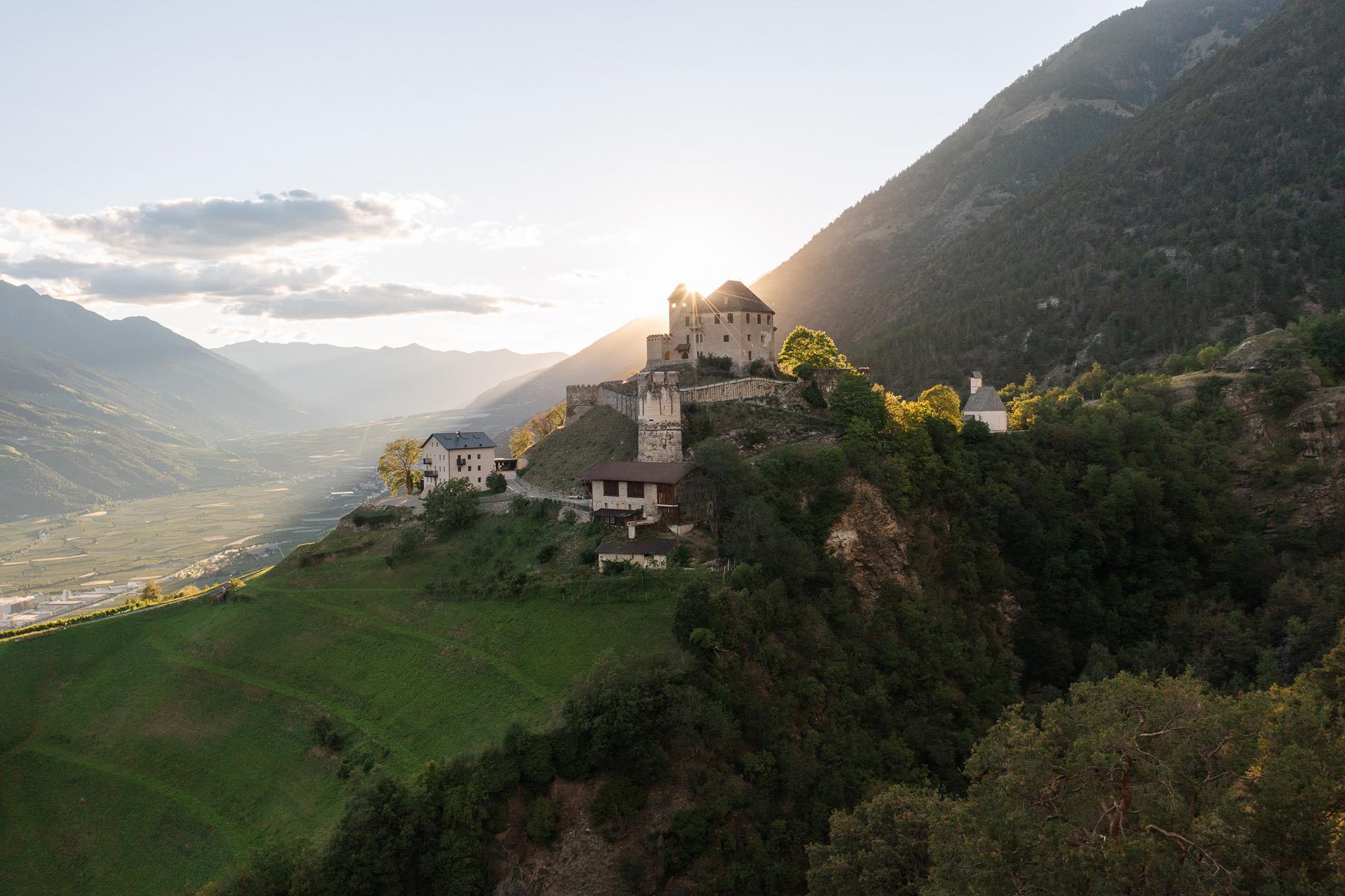
    Four-star ratings are rare for vineyards. But the Calvenschlössl Winegrowing Estate in Laudes in the community of Malles began with a vineyard at 1,000 meters and even went a step further in 2013. Or, to put it better, higher. In the monastery meadow of the Benedictine Abbey of Marienberg, Europe’s highest vineyard was planted. The German word for vineyard is Weinberg, meaning wine mountain, and that can completely be taken literally here.

    In 2004, Hilde Van den dries acquired the Calvenschlössl castle. “Immediately afterward, the desire came upon us to make top-quality organic wine,” Van den dries says. But that is easier said than done, since the slopes around the house are not only steep, they also are situated at elevations between 970 and 1,005 meters above sea level.

    In any case, the extreme locations have also turned out to be a stroke of luck. The southern exposure bestows upon the grapes ample sunshine, the elevation provides coolness, from which grapes with high sugar levels and prominent acidities result. In addition, in both vineyards the focus is not only on resistant grape varieties such as Solaris, Souvignier Gris, Zweigelt, and Cabernet Cortis, but also on careful dealings with nature and thus on a holistic method of agriculture.

    And that also holds true in the winery. “The energy from the spontaneous fermentation from the natural yeast strains of the grapes lend our wines their unmistakable finesse and their unique character,” Van den dries is convinced. The elevation is therefore not the only special ingredient in the wine from the Calvenschlössl Wine Estate in Laudes.
    Wineries
    Ansitz Mairhof - Matthias Bernhart
    Partschins/Parcines, Meran/Merano and environs
    The latest chapter (for the time being) in the history of the Ansitz Mairhof in Parcines, which is over 800 years old and carried historical preservation, began in 1930. It began with one woman and a requisite dose of courage. And it ends in a success story in the form of a family-run estate winery. Or to put it better, it has not ended by far, and the success story is still going.

    In spite of having nine smaller children, Antonia Kofler – the mother of today’s senior boss, Matthias Bernhart – bought the Ansitz Mairhof in Parcines at auction during the period between the wars. It was necessary to scrimp and save for the investment in the truest sense of the word – and only slowly did the estate get going on its own two feet: with cattle, pigs, chickens, grain, hay, and potatoes.

    In addition to the classic self-reliance goods, grapes were soon also planted at the Ansitz Mairhof, thus kindling a passion that has still not left the family to this very day. “There is a lot to do in the vineyard, spread out over the entire year,” Bernhart recounts. “But the best time comes in autumn, with the harvest.”

    But after that, the work is not done, since at the Ansitz Mairhof in Parcines, they make wine with their own grapes. “The work in the winery requires a lot of diligence, precision, and of course the love of a good glass of wine,” says Bernhart with a smile. He and his family continue to develop this recipe with these three ingredients, and a good homemade wine has turned into aromatic gourmet wines: Riesling, Schiava, and Pinot Noir.
    Wineries
    Vineyard Kreithof
    Eppan an der Weinstaße/Appiano sulla Strada del Vino, Alto Adige Wine Road
    The Kreithof is an estate winery filled with tradition whose roots date back to the Middle Ages.
    At that time, a farm was created on a cleared space (in Middle High German, Gereuth) on a hill above San Michele-Appiano, the name of which little by little came under the influences of dialect until it was transformed into “Kreit”. And the way it looks is also different than it was back then. In the eighteenth century, the farmhouse was expanded into a magnificent manor, with the house occupied and the land worked by the Raifer family since 1813.

    Aside from how the farmhouse looks, the economic pillars of the farm have always included winegrowing from the very start. So today, Johann Raifer runs seven hectares of vineyard area. “By far the largest part of our grapevines grow at somewhat higher than 400 meters above sea level on sandy-loamy moraine soils around our farmhouse,” Raifer explains. Just one smaller vineyard that belongs to the Kreithof is located in the vicinity of Lake Caldaro.

    A broad palette of grape varieties is planted that ranges from Pinot Blanc and Sauvignon Blanc to Yellow Muscat and Goldmuskateller to Schiava, Pinot Noir, and Lagrein.
    Wineries
    Föraner Hof
    Ritten/Renon, Bolzano/Bozen and environs

    The Föranerhof estate is located at 800 meters above sea level in the village of Unterinn/Auna di Sotto on the Ritten/Renon plateau. At this altitude, you would not typically expect to find any vineyards, but the Föranerhof has been a wine-growing business (among other things) for several generations. “Our estate is located close to the altitudinal limit up to which wine growing is still possible, which means that not all varieties can be grown here successfully,” explain Verena Plattner and Toni Mittelberger, who run the farm together with their daughter Cecilia and her family.

    The area under vine of their business amounts to 8,000 square meters, and they grow four carefully selected grape varieties – two red and two white – which are adapted to the special conditions present at the Föranerhof estate. In terms of white wine, the Sylvaner is particularly resilient, just like the Müller Thurgau, which by no means only barely survives here: “At these altitudes, the wine develops especially pronounced flavors,” says Cecilia, who, together with her partner, is responsible for turning the family’s grapes into wine. Wine growing has been her passion ever since she was little.

    The red varieties grown here are Schiava (Vernatsch), a grape absolutely typical for Alto Adige, and Zweigelt. “This grape variety from Austria is one of only very few strong red wines that can be grown at 800 meters above sea level,” says Toni Mittelberger.

    But wine is not the only line of business at the Föranerhof. For more than 30 years now, the farm has had its own little nursery growing garden and balcony plants. The family also grows fruit, which is then either dried or used to prepare syrups, fruit spreads and jams.

     
    Wineries
    Taschlerhof
    Feldthurns/Velturno, Brixen/Bressanone and environs
    “Good wine requires one thing above all else: character.” This conviction leads Peter Wachtler with his work at the Taschlerhof in Bressanone. Since the early 1990s, this has consisted of making four white wines whose longevity, fruity bouquet, and a trace of the exotic have been attested to.

    Wachtler himself asserts that the Taschlerhof at the southern part of Bressanone works “with the right portion of passion and a tiny bit of boldness.” In plain language, that means that he is pleased to exchange information with his winegrowing colleagues throughout all of Europe, but he still follows his own path in the vineyard and the winery.
    That all begins in the Taschlerhof’s vineyards at an elevation of over 500 meters, where the not very fertile slate soils, southeastern exposure, and intense rays of the sun are ideal for white wines. Wachtler places great value here upon purposefully reducing the yields and only harvesting the grapes “at their absolute physiological maturity,” since, “Only in that way are the quality and the typical characteristics of the extreme growing locations maintained.”

    At the Taschlerhof in Bressanone, the concentration is on four varieties: Sylvaner, Riesling, Kerner, and Gewürztraminer. Around 60 percent are matured in large acacia barrels, and around 40 percent in stainless steel tanks. “My young wines mature through late spring with constant contact with the fine yeast,” Wachtler says, “and for that reason they are only ready to drink by late summer.” Individual wines, as we learn, need time.
    Wineries
    Winery Niklas
    Kaltern an der Weinstraße/Caldaro sulla Strada del Vino, Alto Adige Wine Road
    Three generations of vintners – With a passion for wine-making

    We are down to earth, but also innovative. We have great respect for Nature, and cultivate grapes only at the appropriate locations. That describes, in a nutshell, the philosophy of the Niklas winery. We view our family heritage as a responsibility to shape and maintain a South Tyrolean wine-growing estate like no other. It embodies the know-how and motivation of three generations of vintners, and is a place where outstanding South Tyrolean red wines typical for their location are created. In the meantime, Dieter Sölva guides the estate’s continued development. Dieter learned the business from his father, Josef, the founder of the Niklas winery, whom he succeeded. Dieter’s son Michael is already adding his unique handwriting to the family business – whose wines are now being marketed throughout the world.
    1 2 3 4 5 6 7 8 9