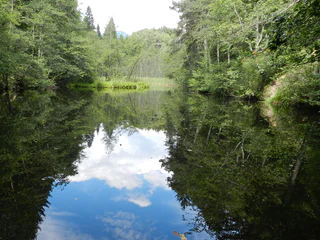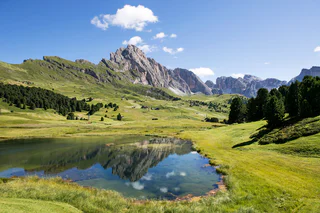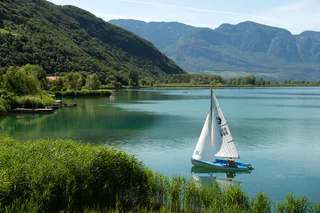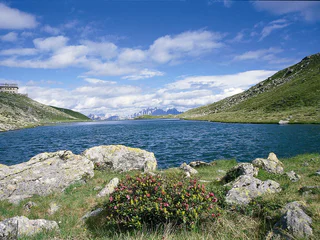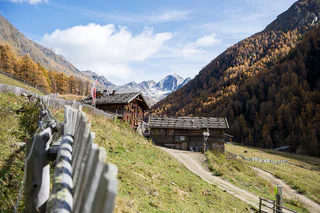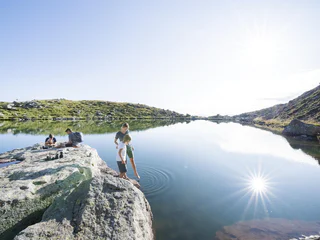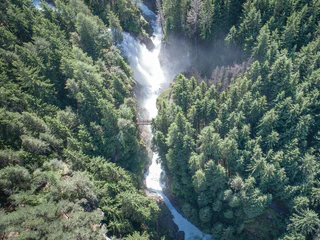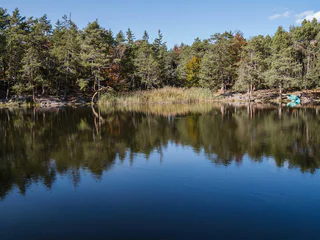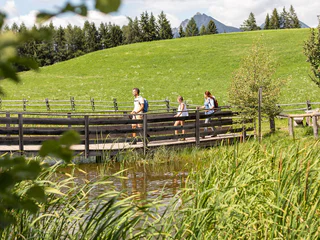
The mountain lake of Covelano/Göflan is idyllically situated in the Stelvio National Park, above the Covelano marble quarry and at the foot of Jennwand summit.
Refreshments stop: Göflaneralm, Haslhof
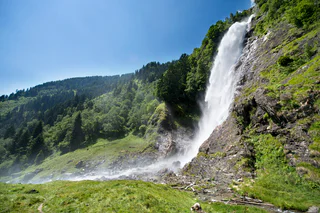
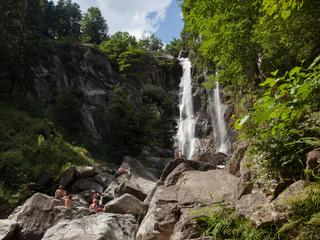
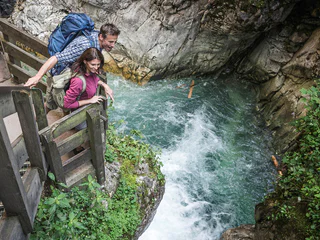
Alpské scenérie odrážející se ve vodní hladině průzračných horských jezer. Spěchající vodopády, u kterých se ve vzduchu třpytí jemné kapky, obklopené lesem a skalami: objevujte stezky, cesty a trasy v blízkosti vodopádů a jezer nebo si udělejte pohodlí na břehu.
The mountain lake of Covelano/Göflan is idyllically situated in the Stelvio National Park, above the Covelano marble quarry and at the foot of Jennwand summit.
Refreshments stop: Göflaneralm, Haslhof
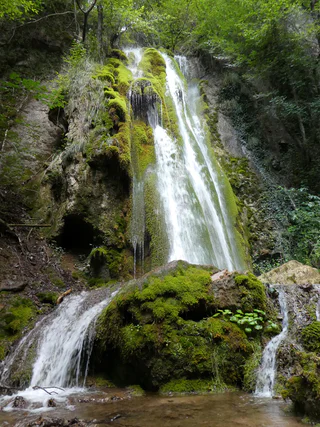
The Tervela waterfall is situated at the opposite of the centre of S. Cristina. The creek has its source at the Sassolungo and after crossing Monte Pana, it falls 50 m and flows into the Rio Gardena.
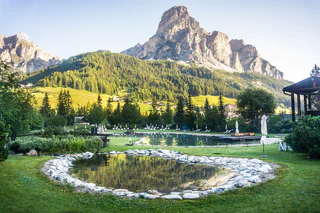
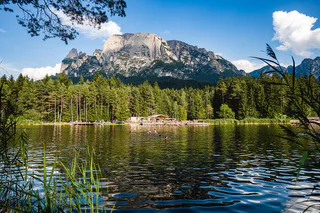
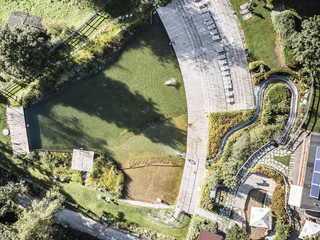
The biotope relaxing zone is frequently visited by young and adult guests that appreciate the three ponds, a lawn with showers, a bar with restaurant and a children's playground.
There are three small lakes: a small pond, a children's pool and a regeneration pond which was built separately, to ensure the protection of the regeneration zone during bathing season. The pond is purified mechanically, but most of all biologically.
Prices:
Adults: € 10,00
Children (7-14): € 8,00
Children (up to 6 years and only if accompanied): € 5,00
1 Entrance + 1 Sunbed with umbrella: 16,00€
2 Entrances + 2 sunbeds with parasol: 28,00€
Neves Lake, 1857m
The round-trip trail around the Neves artificial lake gurantees an unique experience for the whole family (doable even with a baby carriage)
For mountain lovers the Neves Lake is starting point for one of the most beautiful mountain trails in South Tyrol: the Neveser Höhenweg.
Prices:
- up to 1 hour: € 5.00
- 1 hour and 1 minute up to 4 hours: € 8.00
- 4 hours and 1 minute up to 24 hours: € 12.00
- 40,00 € per week
The waterfall Hartungen is located in S. Nicolò/St. Nikolaus directly at the Ultner Höfeweg, a few minutes walk from the Ultner Urlärchen. Especially from May to October, the waterfall is worth a visit.
At the end of the parking lot, pass the game reserve. Trail. n° 9 continues through the forest, along the ditch until it turns left crossing a small bridge over the waters of the glacier. The winding path continues up to three cascades, made up of water from the glacier, then descending to the flat section of the woodlands and back again to the starting point.
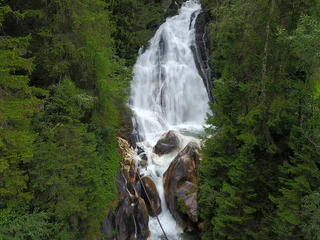
The waterfall trail in Pflerschtal/Val di Fleres is called "Hölle" (in english hell) and lies right at the feet of the Tribulaun summit. The tranquillity in the valley end, the ionized air from the waterfall purifie the respiratory tract and the sounds of the water calm the nervous system.
Dark green coniferous forests, the breathtaking mountain scenery of the Rieserferner mountain chain and, in the midst of all this, shimmering turquoise-green water. This is the dreamlike scenery of the lake called Antholzer See, one of the most beautiful lakes in the Alps! And with 44 hectares and a depth of 38 m, this idyllic pearl of our Blue Valley is the third largest mountain lake in South Tyrol. Located at the head of the valley, it is also very close to the well-known Staller Saddle mountain pass and Austria. At an altitude of approx. 1,640 m, families, nature lovers and outdoor enthusiasts can enjoy countless activities in the Rieserferner-Ahrn Nature Park all year round.
A Natural Monument!
The 82 m high waterfall is fed by the Möltner Brook. The path leads past the old Vilpiano's Wasserwaal from the 17th century. The water was once used to irrigate the fields.
Accessible by foot in ten minutes from the village center of Vilpiano.
Brown, marshy ground surrounds the three Schwarzseen (black lakes), which lie below the Toten. All around you can admire the abandoned mines with galleries and slagheaps, and the imposing peak of Villanderer Berg rising into the sky. The single lakes of the black-lakes-formation are called black, white and blue lake.
At the foot of the rocky walls of the "Grup dl Sela" or Sella Group, the most imposing massif of the Dolomites, you can admire the evocative “cascades de Pisciadú”. The waterfalls, which can be reached from Colfosco with an easy walk through a large clearing, are particularly impressive in spring when, thanks to the thaw, they are rich in water.
From de Costalovara lake you walk on route 12 to Lago di Mezzo. The water-poor Renon still has some lakes, ponds and moors. These protected wetlands are home to a variety of plants and animals. For nature lovers these picturesque and quiet biotopes are popular excursion destinations. The Lago di Mezzo is embedded in a warm pine forest with a view of the Dolomites. Only the fluttering of dragonflies & Co can be heard.
The Lake Tret – also called Lake Santa Maria – is located in Alta Val di Non near St. Felix, at the point where South Tyrol and the Italian-speaking Trentino meet. The way to the sea proceeds through the forest and across larch meadows, by the wayside we watch various forest flowers and many butterflies.
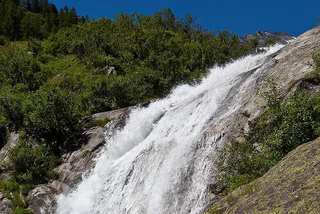
Water is, without doubt, one of the most important natural elements in the Texel Group Nature Park. It runs off nearby glaciers and bubbles up from deep underground springs to fill many crystal-clear streams and lakes. The Partschins waterfall is one of the most impressive falls in the Alpine region.
The thundering water shoots out over a towering rock wall and thunders, rages and roars downwards like a "liquid curtain”. The sun’s rays shine on the drops of water making a fascinating myriad of rainbow colours. The 97 mt. high falls are at their best from May to July, when they swell with melted snow water, or after heavy rain storms (water capacity 4,000 – 10,000 per second). Water in all its mighty, majestic forms – the Partschins waterfall is an absolute must, especially around the end of March to the beginning of April when the snow starts to melt and the falls reach a 50 to 60 lt. per second capacity, at the end of April with an average 100 to 200 lt. per second or the end of May with records of between 350 to 500 lt. per second.
The falls reach their full weight with melted snow from mid-May to the end of June or beginning of July with 5,000 to 6,000 lt. of water crashing over them. The most impressive sight of all was seen in July 1989 when an estimated 10,000 lt. per second went hurtling its way towards the valley.
Alpine Health: The high level of humidity found at the waterfall has an extremely beneficial, refreshing and re-vitalising effect on our body, helps improve the circulation of air in our lungs and boosts our immune system. The “WATERFALL CURE” is recommended as a means of combatting the effects of air pollution as well as for itscleansing action on the breathing mucous membranes. The Partschins waterfall is known to have an exceptionally high concentration of so-called oxygen-ions, estimated at an incredible figure of 50,000 per sq: cm. These particular oxygen-ions are present in our homes as 100 ions pro cm³, 200 ions in town and city air, and 5,000 in mountain and seaside regions. You can either walk up to the bottom of the Partschins waterfall from the village centre in about 1,5 hoursor take the bus line 265. A well-marked, safe path then leads up to a viewing platform with a fantastic panorama out over the nearby valley and imposing mountain peaks.
The Partschins waterfall is fed by various side streams and other smaller falls all along its 8km. journey on through a steep gorge. The watershed of the Texel Nature Park, which is completely encircled by the Merano High Path, totals some 25 sq. km. and includes the highest peak of the Partschins/Parcines area, the Roteck peak at 3,337 mt.
The falls are most swollen at about 20.00 by which time the run-off water from various mountain streams and little lakes, which takes five hours to reach the main stream, has found its way to the waterfall. The water volume decreases during the night.
From Moos/Moso walk up the first road bridge. At 50 meters, turn left on the walkway up to the wooden observation bridges over the Stieber waterfall. From here hikers will have a breathtaking view of the gigantic Stieber waterfall, where the Pfeldererbach stream first plunges 19 meters then 18 meters deep in the Passer river.
A rustic circular hiking trail along the Schwarzenbach/Rio Nero torrent to the waterfall offers a breathtaking natural spectacle offer. The "Katzenleiter" is a stone staircase consisting of 540 steps carved into the rock. The waterfall plunges into a 120-meter-deep gorge and offers a magnificent view of the entire south of South Tyrol all the way to Lake Kaltern. If you continue climbing the steps, you will reach the Brückenwirt inn in Montan/Montagna after a two-hour hike.
Relaxing at the idyllic lake Coldrano. The children can rehearse fishing in the lake and the adults can relax on the lawn around the lake or taste a delicious coffee on the terrace of the restaurant.
The middle part of the "3-Dörfer-Wegs" (three village trail), or 3D-Weg, leads from Entiklar to Margreid. Between lovely rock walls harboring wall ferns and lizards, we wander leisurely upwards to the "Margreider Leiten", steep vineyards with panoramic views of the Etsch valley. The last part follows a somehwat steep paved road into the beautiful little wine village of Margreid.
The end of the Ultental Valley is without a doubt a true power spot. The mystic Langsee lake lies in a hollow fed by numerous block glacier springs. Formed by the retreat of the glaciers of the Ice Age, this mountain lake presents itself as a true work of art of nature. Many legends entwine around this wonderful place of power, which was already visited in the Stone Age as a resting place for hunters.
The Egger waterfall near the rest station Egerhöfe in Antholz Mittertal is now accessible. A unique opportunity to experience a waterfall closely. The hike takes a total of about 45 minutes (up and down).
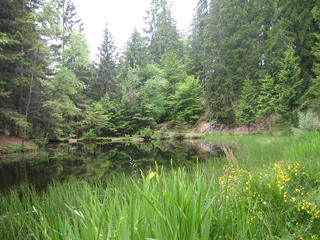
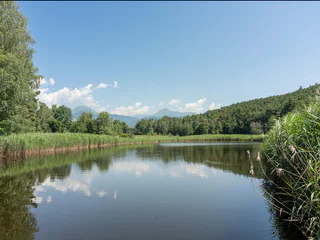
Once you are here, take a hike through the Sommersürs biotope, also called Samesirs, located in a basin between the villages of Naz and Fiumes/Viums. The small habitat of little more than 2 hectares is a biotope of diverse fauna and flora. It is an invaluable refuge for numerous aquatic insects and birds, along with amphibians and reptiles. Cattail, sedge, and marsh clover populate the shallow lake shore.
Other nature habitats in the Natz-Schabs holiday region include Raiermoos, Zussis and Laugen.
The tour leads through the village of Natz and then turns right onto the Villages round trip [Dörferrunde] through the Fruhnwald forest up to the Waldertor viewpoint. Past Viums and the Viummer Kreuz cross, the route leads mainly through forest paths up to Schabs. Continue through the village trip through forest and later through orchards and then go left along the Villages round trip, up to the Flötscher Weiher pond. At the Seehof Hotel, cross the road and continue through meadows and woods, always
along the signposted road to Raas. Continue through the cultural grounds passing the water reservoir back to the street towards Natz. Follow the street to the right, at the Laugen sports field following the sign Dörferrunde. From here, the Villages round trip leads back to the starting point.
Take a walk on the nature trail around the Raiermoos biotope, where you can hear the songs of rare bird types and spot a variety of wildlife. The Raiermoos habitat was originally a large lake that was formed about 12,000 years ago on clayey moraines. Here, primeval populations settled on stilt houses.
Today, the Raiermoos is a biotope and habitat for endangered flora and fauna. Reeds, cattails, rushes, and marsh trefoil surround the lake. It offers a sanctuary to frogs, newts, salamanders, and snakes. Many migratory birds
such as herons and storks find here a safe and peaceful place to stay.
Other nature habitats in the Natz-Schabs holiday region include Sommersürs, Zussis and Laugen.