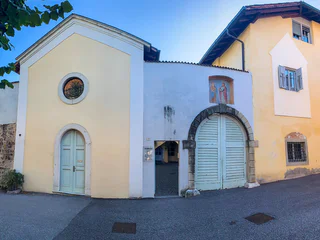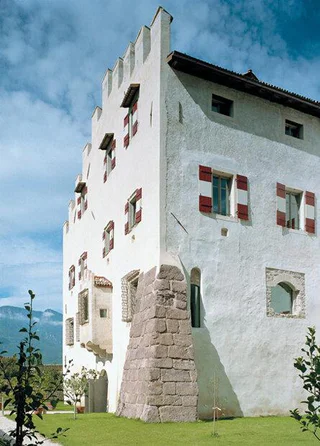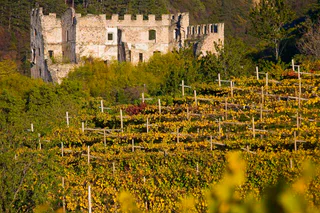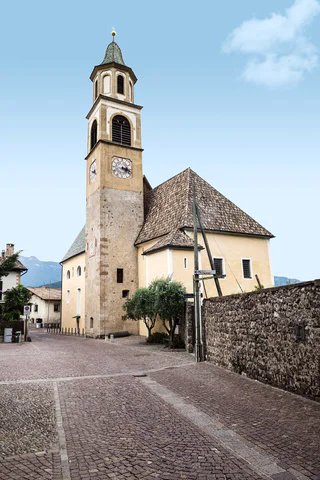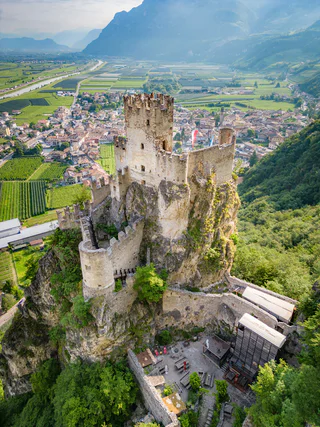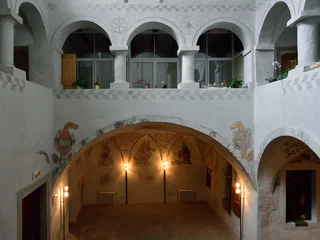
The chapel, dedicated to all saints, is located in the basement of Fahlburg Castle.
Jižní Tyrolsko nabízí bohatství kulturních památek a zajímavostí. Objevte historické budovy, malebná náměstí a fascinující muzea, která vám přiblíží historii a kulturu tohoto regionu. Nechte se okouzlit jeho kulturní rozmanitostí a prožijte nezapomenutelné chvíle.
The chapel, dedicated to all saints, is located in the basement of Fahlburg Castle.
..................................................................................................................................................................................................
"The Sleeping Giant"local recreation area in Neumarkt/Egna. The "The Sleeping Giant" park is a local recreation area with an area of 8 hectares, equipped with a playground for children, a relaxation area for adults, picnic space, and a pond for fishermen. A giant is located in the middle of the park, arranged for children to climb on. Adults can relax on several hammocks, park benches, and sunbeds. The recreation area is located near the Trodena River, a "sleeping giant" because of its calm flow but, once "awakened," it can get really dangerous.
..................................................................................................................................................................................................
The Laas Marble World invites you to experience the legendary Lasa marble with all your senses. Surrounded by the impressive nature of the Vinschgau Valley/Val Venosta, visitors learn about the history of this special stone, from its historical beginnings of quarrying in the Jennwand, a mountain above Laas/Lasa, to the arduous transport on the unique inclined railway and the modern processing technology of today.
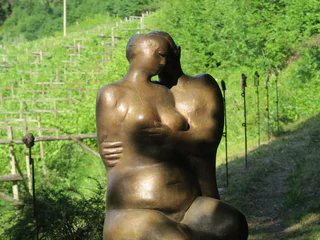
History comes alive in the Laas Marble World. Numerous display boards bear testament to the hard work of the quarrymen and the skilful processing techniques that have made Lasa marble world-famous. A particular highlight is the sculpture park, where impressive works of art made from the gleaming white marble can be admired.
In addition to its fascinating history, the marble world also offers a place of rest and recreation. Shady seating and elegant marble tables invite you to linger. There is a marble sandpit for younger visitors while those interested can try their hand at carving a block of marble themselves.
Sanitary facilities and fresh drinking water are available on site to make your stay as pleasant as possible. The Laas Marble World is an experience for the whole family: a place where nature, culture, and craftsmanship come together in a special way.
Admission: 4.00 euros per adult and 2.00 euros per child aged 6 and over.
Tickets can be purchased directly on site at the ticket machine.
One entry is free with the Südtirol Guest Pass Vinschgau (May – mid-November 2025).
..................................................................................................................................................................................................
..................................................................................................................................................................................................
Pojer Waterfall in Luttach/Lutago – A pure nature experience!
Experience the impressive power of nature up close at the Pojer Waterfall in Luttach/Luttach. This picturesque waterfall offers not only a breathtaking backdrop but also a refreshing retreat in the heart of nature.
Enjoy the soothing sound of the water and let yourself be enchanted by the untouched beauty of the surroundings. The trail leading to the waterfall takes you through an idyllic landscape – perfect for a hike or a relaxing walk.
A natural wonder you shouldn’t miss – come and experience the Pojer Waterfall!
From San Atonio's bridge you may take the St. Oswald walk, wich will take you to Eberle Hotel and to St. Magdalena hill. Following the Eisack river, and crossing over it, you'll arrive at the Kohlern cable car and at Virgl Hill, from where you can take another path back to Haselburg Castle.
The parish church of Nova Ponente, a Gothic building dating from the 15th century, has an impressively beautiful sandstone cladding. The inscription in the choir vault gives its date of origin: the cornerstone was laid on 5 July 1455 by Pastor Johannes Steel. Below the inscription is the coat of arms of the Diocese of Trento with the eagle, along with that of the then Bishop Georg Hack with its thin branch, also chosen as the heraldic symbol of the municipality of Nova Ponente.
The building was completed in sections, as suggested by the differences in the foundations and the sandstone cladding. Construction work was not completed until 1498, with the church consecrated on 16 September of the same year. In order to imagine it in its pure and original form, the new sacristy at the northeast corner and the organ loft with its outside staircase must be ignored. The interior of the church was vastly improved by the most recent renovation in the summer of 1975. The two neo-Gothic altars date from 1900, with a new organ installed in 1976.
Of particular note in the church are the four old relief panels on the high altar, showing the Nativity, the Adoration of the Magi, the Presentation at the Temple and the Death of the Virgin. The panels are from a famous large triptych, created around 1420 by the Master Hans von Judenburg for Bolzano’s Parish Church, as was the group of the Visitation on the wall of the choir. The main figures on the high altar – Our Lady of the Rosary and the church’s two patron saints - are beautiful works by the Innsbruck sculptor Dominikus Trenkwalder from around 1900. The relief figures of St. Barbara and St. Catherine as well as the relief panel of the Visitation, also on the choir walls, date back to around 1500. The sandstone pulpit from the early 16th century is held by Karl Atz in his “History of Art from Tyrol and Vorarlberg” to be one of the most beautiful of its kind in the entire land.
Old relief medallions of the mysteries of the rosary are inserted into the neo-Gothic rosary altar; the altarpiece was created by Franz Unterberger. Franz Haider’s beautiful nativity figures can be seen at Christmastime on this altar: his figurines and statues of saints are to be found throughout the Reggelberg area and he was a long-time resident of Monte San Pietro. The bell tower is for the most part much older than the present-day church. It dates back to the Romanesque era; inside can clearly be seen two rows of coupled arched windows that were later walled up. The tower formerly belonged to the old parish church of St. Benedict, documented as early as 1265. Today’s cupola was added in 1793 after lightning badly damaged both the tower and the church roof.
Another special feature of the church is that the pews have brass plaques, some with a rune-like mark next to the occupant’s name. These are the old house and farm marks of Nova Ponente. Each farm would use its mark to identify tools, grain sacks, logs and the like that were offered for sale. Many such marks can also be seen painted with red ochre on the outer walls of the church, now faded on account of the wind and rain. The impressive war memorial (1967) on the northern wall of the cemetery is by the South Tyrolean sculptor Martin Rainer, who was in 1976 awarded the Walther von der Vogelweide prize.
The church Saint Martin in Fundres/Pfunders is mentioned for the first time in th year 1397. The contemporary church was built in 1808 - 1810 and contains a bell tower with an imperial roof from the 14th century. The barrel vault is decorated with ancient frescos. Generally speaking a very nice, little church.
At the entrance of the Tschamin Valley, you’ll find the visitor centre of the Sciliar-Catinaccio Nature Park, located in the historic Steger Sawmill – a rare, water-powered Venetian sawmill.
Until 2021, the building served as the Nature Park House Schlern-Rosengarten, making it the oldest nature park centre in South Tyrol. In recent years, it has been carefully restored, and the sawmill has been brought back into working condition.
Inside, visitors can explore authentic traces of traditional alpine craftsmanship and living culture – with the original saw and a reconstructed living area offering a glimpse into the past.
Free admission!
The neo-gothic church of San Genesio/Jenesien was approximately built around the mid 15th century, its patron saints are Saint Genesius, Saint Sylvester and Saint Margareth.
The church of Barbian was built in the 13th century consecrated to the apostle and patron Saint Jacob. Today the only remaining of the old church is he bell tower. The church was constructed in a Romanesque style and in the year 1472 it obtained Gothic elements. In 1874 – 1877 the Neo-Romanesque nave was added to the Gothic main body (today’s sacristy). The inclination of the campanile is attributed to the different grounding on which the tower was built. The half on the downhill side lies on the unstable soil of the Central Uplands and the other half on solid quartz-phillite-rocks. Ing. Fulvio Pisetta carried out a mechanical intervention in 1985 – 1988 to assure the stability of the church tower. Height: 37,00 metres Inclination: 1,56 metres
Welcome to SculpGarden25, a unique fusion of art and nature in the enchanting Staudenparadies Seidnerhof. From April 12 to October 25, 23 artists will showcase over 60 sculptures and installations, engaging in an inspiring dialogue with the diverse plant world.
Amidst blooming perennials, delicate grasses, and striking trees, the artworks invite visitors to pause, marvel, and reflect. The interplay between nature and art creates an atmosphere that is both moving and inspiring. The sculptures blend seamlessly into the ever-changing garden landscape, highlighted by the shifting light and seasons.
Complementing the exhibition is a diverse program of events, including the opening on April 12, readings, concerts, themed events, and Aperitivo Lungo on multiple dates. Step into this fascinating world where art and nature intertwine – an experience for all the senses!
Nestled in the historic Steinach district of Merano, the Passirio Gate – also referred to as the “Pseirer Gate,” named after the German term for the Passeiertal Valley – is a striking remnant of the city’s medieval fortifications. This stone tower marked the northern boundary of the old city wall and functioned as both a defensive structure and a checkpoint for trade and travelers entering from the Passeiertal Valley. Of the original four city gates, three remain today. The fourth, the Ultimo Gate, once located on Freiheitsstraße street and later rebuilt farther west, was demolished in 1884.
Characterized by its slim, tower-like form, the Passirio Gate rises over three stories and features small windows and a steep gabled roof. A pointed arch forms the entrance, while the southern interior wall is adorned with a fresco of the red Tyrolean eagle – a powerful symbol of Merano’s historical ties to the County of Tyrol.
In the Middle Ages, the gate played a vital role, as it guarded access to major trade routes over the Timmelsjoch and Jaufen Pass passes. Because the valley floor was largely marshland, merchants and travelers used mountain routes to reach the Ötztal in North Tyrol and continue on to Innsbruck. The gate thus became a strategic point in the flow of goods and people.
Today, the Passirio Gate serves as a picturesque starting point for scenic walks, such as the popular Tappeiner Promenade, which offers sweeping views over the city. Just a short stroll away are other cultural highlights, including the Palais Mamming Museum, the Powder Tower, and the St. Barbara Chapel.
A visit to the Passirio Gate is more than just a glimpse into medieval architecture – it’s an invitation to explore Merano’s rich past and vibrant cultural tapestry.
You will soon find more information about the Koflmühle in Prissian/Prissiano here
The Marian Sanctuary is located in the village of Senale in the region of Alta Val di Non. Various legends surround this place of pilgrimage, on of the oldest of South Tyrol.
On 1.184 the first stone of the Sanctuary was placed. On 1.432 the church was enlarged, to get the present shape. At the beginning of XIV century the pilgrims flow, decreased, so the convent, attached to the hospice, lost its independence, then to belong to Augustinian order of Gries, Bolzano.
The auditorium can be used from cultural and sports associations, corporate bodies or private individuals for the organisation of events and other initiatives of public interest.
Show program: https://www.fondazioneteatro.bolzano.it/venue/teatro-comunale-di-gries/
The pilgrimage church Maria am Sand, with its picture of the Virgin Mary possessing miraculous powers who gives the Christ baby a pear, is the old parish church of Milland and goes back to the 14th century. Around the middle of the 15th century, the church was extended with a vault in the nave, a tower as well as a pointed arch-portal and it was changed into Baroque style in the 18th century.
The Holy Cross Chapel, built in 1755 in Rasciesa di Fuori (over 2200 m) is also worth a visit. The chapel was restored in summer 2012.
The chapel is located at Resciesa and can only be reached on foot in about 45 minutes, starting from the top station of the Resciesa funicular. It is a flat and easily walkable trail suitable for the whole family.
The Rio Pusteria Fortress can be found at the entrance to the Val Pusteria, between the villages of Rio Pusteria and Vandoies. The fortress is directly located along the main road, also the Pusterbike Cycle Route runs past this impressive place of interest. Exactly in this place, the borderline between the countships of Goerz and Tyrol ran in 1271. For this reason Meinhard, Duke of Carinthia, had a dam built, that is to say the castle-like Rio Pusteria Fortress.
Actually the original building was located 600 m in the west of the present-day location and consisted of a long-drawn-out barrage as well as two turrets. The ancient fortress was built according to the model of Mediaeval dam. The construction material consisted of natural and homogeneously-sized river stones, which were hardly modified. The last documents regarding this building are dated 1340.
The newly-built construction, that is by the way preserved still today, bears the hallmarks of Sigismund, Archduke of Austria. The fortress is decorated by round turrets, while a dam stretches up the forested slope. In fact, the Rio Pusteria Fortress not only used to be a toll station, but was also residential building and dam. The building can be visited in a guided tour in summer months.
The succursal church of St. Ägidius in Raas is a late-Gothic building, and was completed by the constructor Thomas Maurer in 1532. The neo-Gothic interior mostly dates from around 1880. On the high altar, one can see St. Ägidius, the patron of the church and the protector of viticulture. In Raas, the now rare custom of the bread donation and bread distribution is still practised on the day of the church patron in September.
The church dates back to the 12th century, but probably its origins are even more remote. The Romanesque building and the Lombard-style bell tower have been subject to many changes. Inside, there is a unique cycle of frescos in Byzantine style dating from 1200-1220. On the ouside walls there are other, probably late 14th century, frescos. Masses (in Italian): Weekdays: 8:00 a.m
The Meizger-Stöckl, built in 1816, is a Mariahilf chapel in Antholz Niedertal.
Cheese dairy Plattkofelschwaige hut
Homemade goat cheese and we have our own cow milk.