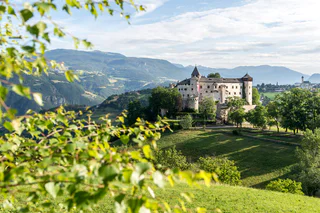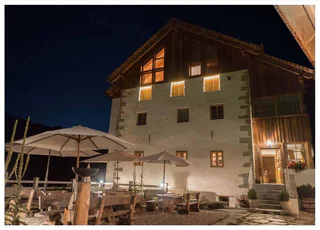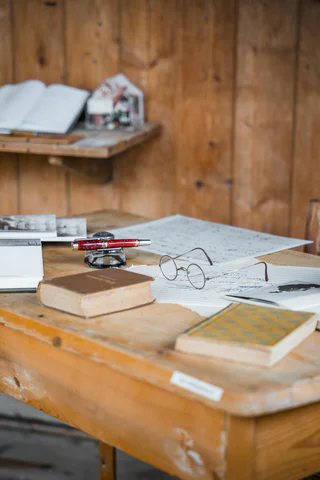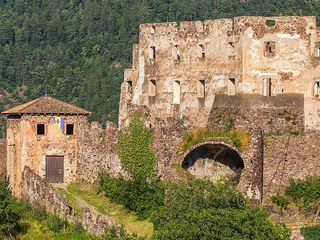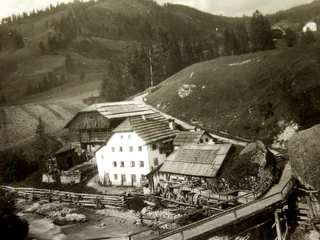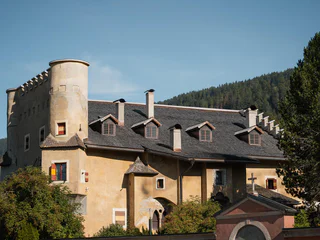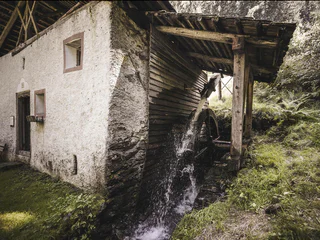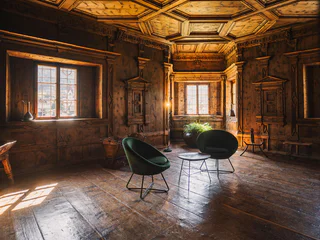
Once representative residences of noble ladies and gentlemen or sturdy castles and places of defense – today, thanks to careful restoration, they serve as fascinating museums, charming hotels, unique restaurants, or event venues. Even though some castles or fortresses can now only be visited as ruins, all these publicly accessible walls tell a unique story.
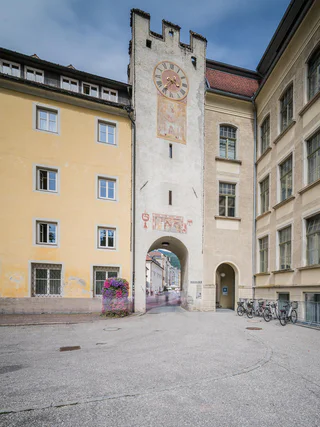
The Ursuline Gate is located near the Ursuline Church at the western entrance of the "Stadtgasse". It was enlarged in 1758 to allow a large fountain to be transported into the town. The fresco was designed by Johannes of Bruneck in about 1420.
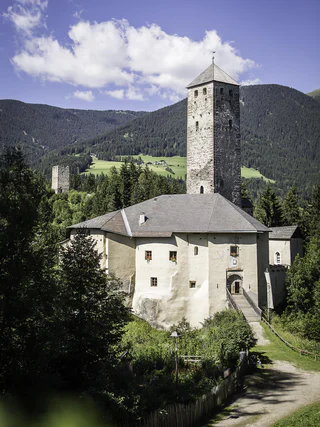
At the entrance to the Gsiesertal Valley, Castle Welsperg rises proudly above Welsberg on a rocky terrace – one of South Tyrol’s oldest and best-preserved castles. Its 22 m keep, built in 1126, once served as both watchtower and stronghold. The noble Welsperg family shaped the region’s history for centuries. Today, the castle hosts art exhibitions, concerts, and cultural events during the summer.
The Castle Ehrenburg was the residence of the Sirs von Ehrenburg, who were later called von Künigl. It was built in the 12th century. During the 15th century, the castle was extended, and in the year 1512, it was extended again with the arcade yard. In the year 1732, it was converted into a baroque castle. The big hall, the bay windows, the wooden paneling, and the paintings on the ceiling, as well as the castle chapel are very remarkable. The castle is not open to visitors.
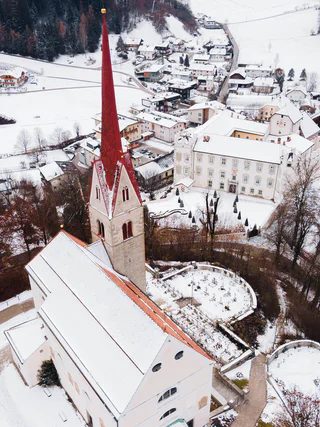
The castle is located below the church. It can only be visited from the outside.
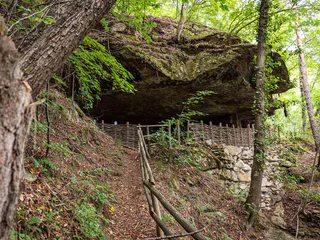
The ruins of Salegg are not far from the Hauenstein ruins, at the foot of the might rock face of the Santner, hidden deep in the forest. The castle dates back to the 12th century and were passed in the hands of the Wolkenstein dynasty.
Today all hat remains of its former glory are the castle walls, and yet the site continues to emanate a very special, mysterious energy.
According to an old legend, a secret passageway runs between the two castles Hauenstein and Salegg.
Built around the year 1000, strictly linked with the history of St. Lorenzen and the central Pustertal.
Nowadays is the Castle Michelsburg privately owned.
Once known as "Lucke" (or hole), the gate carries a painting by the South Tyrolean painter Rudolf Stolz (1874-1960) which shows Saint Florian, the Bruneck coat of arms and the town's founding bishop, Bruno. In Florianigasse, St. Florian, a work by the Bruneck artist Josef Bachlechner (1871-1923) can be seen.
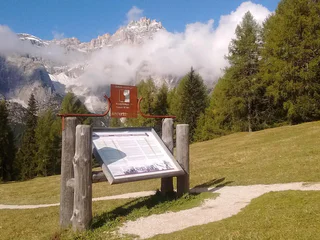
The Engelrast viewing platform on Puflatsch offers a breathtaking 360° panoramic view of the Alpe di Siusi, the Val Gardena and the Dolomites. The platform is surrounded by a metal plate that gives a detailed description of the fantastic mountain panorama of the entire Alpe di Siusi with Sciliar, Sassolungo and Sassolungo, as well as the surrounding mountain ranges. You can find out which mountains you can see in which direction of the sky and how high the peaks are. A nice detail of this platform is the little angel enthroned above this vantage point. A visit to this magnificent viewpoint with some wooden benches is worthwhile. The Engelrast is located near the mountain station of the Telemix Puflatsch. You can reach the viewing platform on foot from Compatsch on the Alpe di Siusi following hiking trail no. 14 or by taking the Puflatsch cable car.
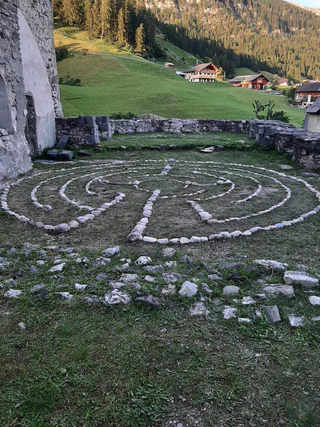
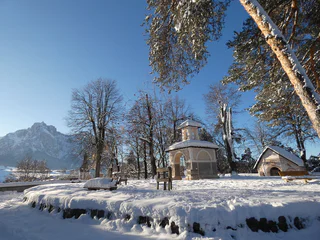
In 2022, on the initiative of the meditation group of La Val, and under the direction of labyrinth expert Gernot Candolini, a labyrinth was built in the centre of the area occupied by the former church of San Genesio. It is a simple Gothic labyrinth, consisting of five paths traced with brook stones. Many things here in Dlijia vedla remind us of the transience of life: the remains of the old church walls, the abandoned cemetery.
Memento mori - Memento vivere!
Everything passes quickly, and the moment never stops. So be present and aware, enjoy the view, feel the hope that lurks in life, let yourself be inspired and blessed by goodness and change.
"This place here is a place of power, you must make use of it" Dr. Karl Gruber, Regional Conservator
Walking through the Raintor Gate, you will reach the Oberstadt district, where the Parish Church is also located. Many years ago, this gate was not very important for traffic; in fact, it was mainly used to connect the town center with the main cemetery.
Ortisei is the capital of Val Gardena, famous for its picturesque pedestrian area with great shops and cafés and its ornate woodcarvings.
This idyllic part of Val Gardena offers the possibility to enjoy the magic pedestrian area during your holiday with the breath-taking view to Sassolungo.
Shopping in Val Gardena is a fun experience. From ski suits to haute couture: you have a great choice. After strolling round the shops there are plenty of restaurants and cafés where you can indulge your palate.
The South Tyrolean Folklore Museum is the oldest of the provincial museums in South Tyrol and offers a view of social life in the past. The noble residence “Mair am Hof”, built in the 17th century, gives you the opportunity of following a striking itinerary through the refined world of local aristocracy. The stately rooms of the landed gentry and the collections of the museum are located inside the residence. Translocated original farm houses, craft workshops and cottage gardens are situated on the three hectares of the green area. A walk through the open air site takes you into the everyday world of various peasant groups of the past: from the self-sufficient farmers to rural craftsmen, cottagers and labourers.
At the foot of the might rock face of the Santner, hidden deep in forest, lies the legendary castle ruin of Hauenstein. The castel dates back to the 12th century and was built by the Lords of Hauenstein and enlarged in the 15th and 16th century. One of the owners was the famous minnesinger Oswald von Wolkenstein.
Today all that remains of the former glory are the castle walls, and yet the site continues to emanate a very special, mysterious energy.
According to an old legend, a secret passageway runs between the two castles of Hauenstein and Salegg. And every so often, or so they say in the area around the Schlern, you can hear the spine-chilling wails of a banished damsel.
Witches'spring: adventure path with the witch Curadina to the sulfur springs
The Thurn ruins sit on a wooded hill above the Gsieser stream, opposite Welsperg Castle. Built in the 13th century, the fortress was abandoned in the 17th century and destroyed by fire in 1765. The 22 m tower still stands in good condition today. The ruins can be reached on foot and combined with a visit to nearby Welsperg Castle.
Ladin Museum - Tor Castle In the very heart of the Dolomites live more than 30,000 Dolomite Ladins whose identity is characterised mainly by two important features: the uniqueness of their language, which derives from popular Latin, and the extraordinary mountain landscape at the heart of the southern Alps. It is only thanks to the physical characteristics of this landscape that the Ladin language has survived today. It is the eldest of all languages spoken in this region and is restricted by the Italian and the German cultural and linguistic areas that surround it. The way through the museum focuses on some significant aspects of the present and past lives of the Dolomite Ladins, highlighting the important influences of cross-regional events on the lives of the population and pinpointing the existing interrelations between landscape forms and lifestyles. The museum is housed in the Ciastel de Tor, a castle dating back to 1230, created as a fiefdom of the Bishops of Brixen.
The castle is available as a wedding venue for couples interested in crowning an unforgettable day and experiencing a fairytale moment in a medieval castle.
Stadtgasse, the main shopping street in Bruneck, is fringed on both sides by picturesque houses, some of which still display ancient frescoes; the various gable structures are noteworthy.The buildings on Stadtgasse are exclusively residential, with shops and inns located on the ground floor.
The former water station in Welsberg, with its octagonal tower, is a remarkable technical monument from the Austro-Hungarian period. Inaugurated in 1871, it served as a “fuel stop” for steam locomotives. Together with the depot and railway houses built in 1926, it forms a rare ensemble of historical railway engineering, protected as a heritage site since 2004.
Is it your dream to share a table with knights or even live at a castle? Neuhaus Castle makes it possible, for special events and weddings. In summer, the castle is also a venue for art and culture.
Guides/programmes: no private guided tours. The program includes art exhibitions, musical events, and outdoor games. The tavern and castle are open throughout the year.
BOOKING REQUIRED!!
Site of the Roman settlement Sebatum, once spreading from the Schraffl-Bühel vis-à-vis the Heilig-Kreuz-Kirche guite far downstream the Rienz on both sides (new digs have been undertaken from time to time). There are remains of residential buildings, storehouses and troop quarters.
Roman Milestone of the Emperor M. Opellius Severus Macrinus and his son Diaduminanus (located on the main road, branching off towards Sonnenburg). The Roman milestone was found in Sonnenburg in 1857. Today the milestone is located at the entrance of the Museum Mansio Sebatum.
It is the ruin of a castle once belonging to the lords of Aichach in the 12th century, whose decline is linked to bitter disputes with the lords of Kastelruth. The lords of Kastelruth got hold of the castle and kept it until 1741. Hiking route no. 7a from Seis.
The lovely big bishop's castle is situated on an easily accessible hill overlooking the town and watches over the buildings of the old town as if it still needed to protect the lives and safety of its residents. The main entrance to the castle is the southern gate, which was once reached via a drawbridge.
The famous mountaineer, Reinhold Messner, opened the new Messner Mountain Museum "MMM Ripa" in the castle.
The romantic Castle ruin Rafenstein rises high above the city of Bolzano at the entrace of Sarentino Valley.
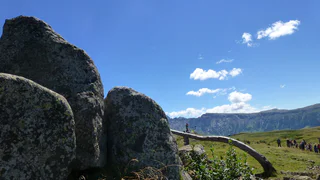
The Witches’ Benches The resting place of the Sciliar/Schlern witches on the Bullaccia/Puflatsch mountain is a truly mythical location. Starting point: Alpe di Siusi/Seiser Alm